Core Formulation Building Blocks for Household Cleaning
Household cleaning represents the largest segment in daily chemical industry. Products including dishwashing liquid, laundry detergent, laundry powder and heavy-duty degreasers rely fundamentally on formulated surfactant systems. Surfactants serve as the functional core of detergents. Combined with chelating agents, thickeners, optical brighteners and other functional additives, they form stable and high-performance cleaning formulations, determining detergency, foaming behavior, handling experience and environmental performance of cleaning products.
Household cleaning represents the largest segment in the daily chemical industry. Products including dishwashing liquid, laundry detergent, laundry powder and heavy-duty degreasers rely fundamentally on formulated surfactant systems. Surfactants serve as the functional core of detergents. Combined with chelating agents, thickeners, optical brighteners and other functional additives, they form stable and high-performance cleaning formulations, determining the detergency, foaming behavior, handling experience and environmental performance of cleaning products.
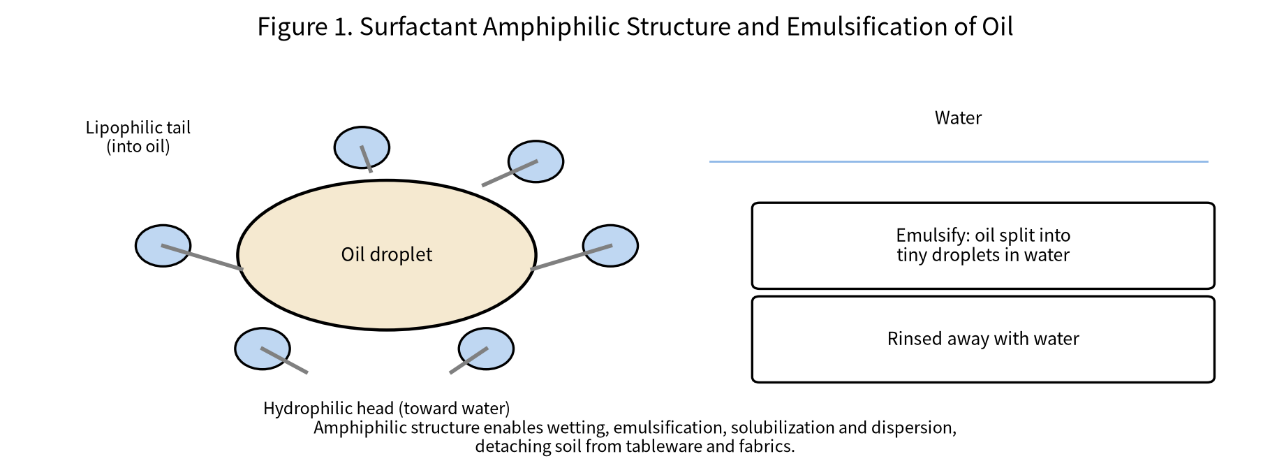
Surfactant molecules have a distinctive amphiphilic structure: a hydrophilic group that readily dissolves in water and a lipophilic group that binds to grease and soil. When cleaning products contact oil stains, lipophilic segments penetrate grease while hydrophilic segments remain in the aqueous phase. Through wetting, emulsification, solubilization and dispersion, bulk grease is broken into tiny droplets, detached from tableware or fabric surfaces, suspended in water and removed during rinsing.
Single surfactants usually have inherent limitations. The industry widely adopts blended anionic and nonionic surfactants to complement each other for balanced detergency, foam stability and water-hardness tolerance.
2.1 Anionic Surfactants: Primary Detergency Components
Typical examples include LAS (linear alkylbenzene sulfonate) and AES (alcohol ether sulfate). LAS features high cost efficiency and strong detergency, widely used in traditional laundry powder and soap-based cleaners. AES delivers milder irritation and rich, stable foam, commonly applied in dishwashing liquid and laundry detergent for grease and protein-stain removal. Anionic surfactants act as the main workhorse to remove most stubborn soil.
2.2 Nonionic Surfactants: Emulsification Boosters
A typical example is AEO (alcohol ethoxylate). Nonionic AEO carries no electric charge and exhibits excellent hard-water resistance with superior emulsifying capacity for heavy oil. It is preferred for low-foam formulations and heavy-grease removers. When blended with anionic surfactants, AEO compensates for the performance drop of anionic surfactants in hard water and enhances solubilization of cooking grease and body soil.
2.3 Supporting Functional Additives to Complete the Formulation
Chelating agents such as EDTA and sodium citrate sequester calcium and magnesium ions to soften water, preventing precipitation that weakens cleaning performance; sodium citrate is a green alternative for phosphorus-free formulations. Thickeners such as sodium chloride and carbomer adjust the viscosity of dishwashing liquid and gel cleaners to avoid excessive flowing and improve the user experience. Optical brighteners attach to fabric fibers, absorb ultraviolet light and emit blue light to offset yellowing, brightening textiles in laundry powder and liquid detergent.
Carefully tuned combinations of these raw materials form commercial detergent formulas. Ratios are adjusted to fit dishwashing, fabric-washing and kitchen-degreasing scenarios.
HLB (hydrophilic-lipophilic balance), foaming property and biodegradability are core parameters for surfactant formulation. HLB governs the type of soil that can be cleaned; foam profile differentiates high-foam hand dish soap from low-foam machine laundry detergent; biodegradability defines the environmental grade of the product.
Phosphorus additives were once widely used but cause eutrophication in water bodies. The industry trend is clear: phosphorus-free, mild and readily biodegradable green surfactants. Modified AEO and bio-based surfactants are continuously developed to balance cleaning power and environmental compatibility, which is the long-term upgrade direction for detergent raw materials.
The core of household cleaning products lies in the scientific blending of anionic and nonionic surfactants, synergized by chelating agents, thickeners and other auxiliaries. This fine chemical system enables grease separation and emulsification. As consumers raise requirements for safety and sustainability, green biodegradable surfactants are gradually replacing traditional materials and become a key growth direction for fine chemicals in household cleaning.

