In the modern new material industry system, the compounding of inorganic materials and organic polymers is the core path to achieve performance leap. However, there is an inherent interfacial compatibility challenge caused by differences in surface chemical properties. Inorganic fillers, glass fibers, ceramics and other materials can hardly form stable bonding with organic matrices such as resins, rubbers and fibers, easily resulting in interface delamination, failed stress transfer and performance degradation.
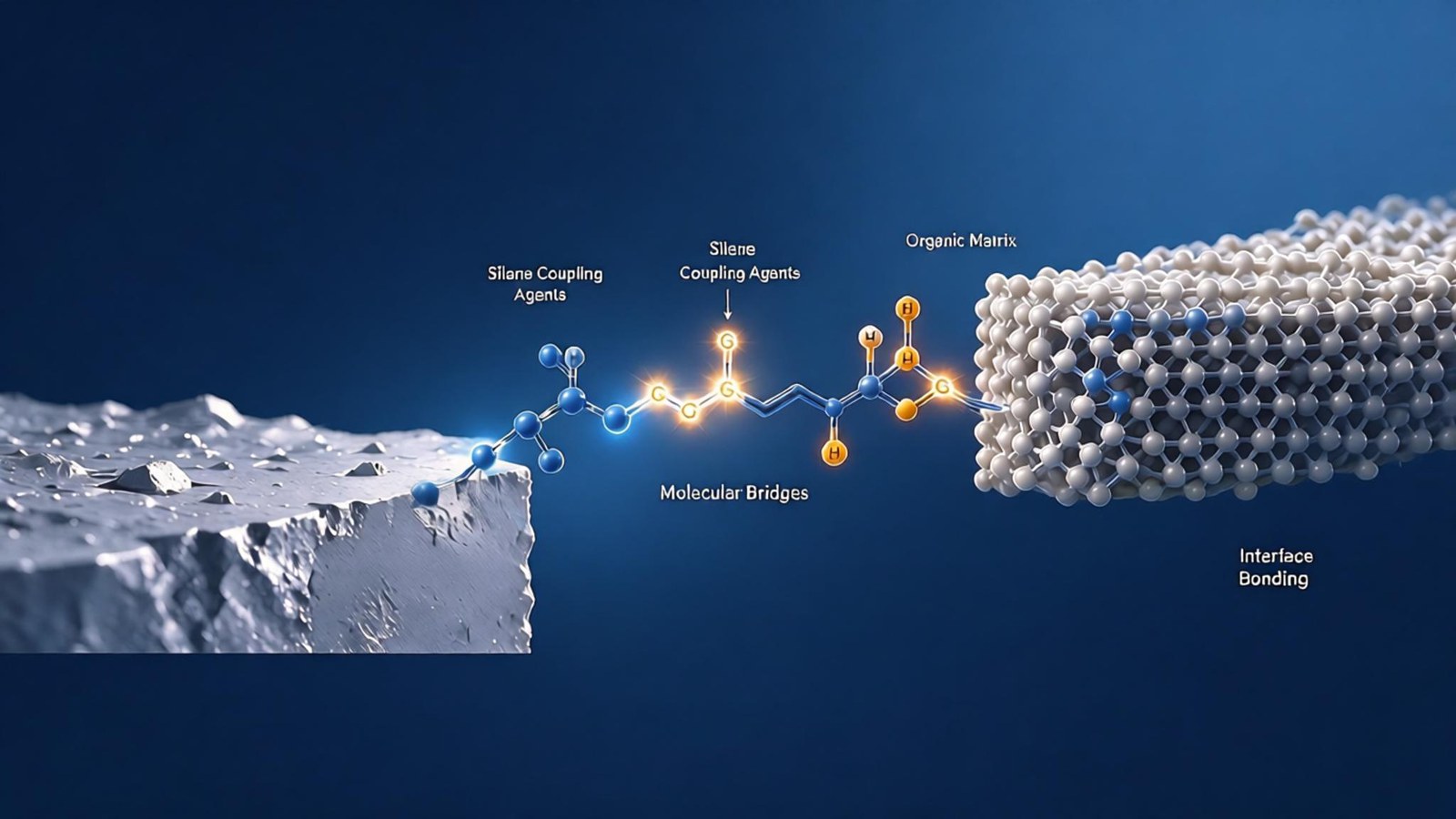
Silane coupling agents are special organosilicon compounds with bifunctional structures. Thanks to the unique molecular design of “one end inorganic-philic and the other end organic-philic”, they become key materials to solve this problem, reputed in the industry as the “chemical bridge” for material interfaces. First developed in the 1940s originally as glass fiber surface treatment agents, silane coupling agents have gradually expanded into dozens of sectors including composite materials, plastics, rubbers, coatings, adhesives, electronics & electrical engineering, textile & chemical fibers. They have become indispensable functional additives for R&D and production of high-performance materials.
This paper focuses on the technical nature and application value of silane coupling agents, systematically sorting out their core functions and mainstream application fields. It analyzes the performance differences and scenario adaptability of five classic grades: KH550, KH560, KH570, KH151 and KH171. It further elaborates on innovative applications of silane coupling agents in spandex fiber, fully demonstrating their core role in boosting material performance and industrial technological iteration.
The general chemical structure of silane coupling agents carries two functional ends, each playing a distinct role at the interface:
| Group | Function |
|---|---|
| Y Organic functional group |
Amino, epoxy, vinyl, methacryloxy, etc., which reacts or forms strong interaction with organic matrices such as epoxy resin, polypropylene and acrylate. |
| OR′ Hydrolyzable alkoxy group |
Methoxy or ethoxy. Upon contact with water or hydroxyl groups on inorganic material surfaces, it hydrolyzes to form silanol groups, which further form covalent bonds with the surfaces of glass, silica, ceramics, metal oxides and other inorganic substrates. |
Core applications fall into four categories:
Surface modification of inorganic fillers. Solve agglomeration and poor dispersion of calcium carbonate, talc powder, white carbon black, aluminum hydroxide and other inorganic fillers in organic matrices. Coating treatment by silane coupling agents converts fillers from “physical filling” to “chemical bonding”, improving mechanical strength, water resistance and heat resistance of composites.
Glass fiber sizing treatment. Serve as core components of glass fiber sizing agents, enhancing interfacial bonding between glass fiber and resin. They greatly improve wet mechanical strength, electrical performance and weather resistance of glass fiber-reinforced plastics and composites, which are critical guarantees for wind turbine blades, automotive lightweight components and aerospace structural parts.
Interfacial adhesion enhancement. Widely used in adhesives, sealants and coating systems as adhesion promoters. They strengthen bonding strength between organic coatings and substrates including metal, glass and ceramic, solving industry pain points such as coating peeling, poor boiling resistance and salt spray resistance.
Polymer modification and crosslinking. Some silane coupling agents feature crosslinking capability. They participate in polymerization reactions of organic polymers to realize crosslinking and curing, improving structural stability, solvent resistance and mechanical properties of materials, suitable for silicone rubber, thermoplastics and many other systems.
Silane coupling agents are core additives for composite industry, most widely applied in glass fiber reinforced composites and mineral-filled composites.
Plastic modification is an important application scenario. Modification of inorganic fillers via silane coupling agents significantly improves comprehensive performance of general plastics and engineering plastics.
In rubber industry, silane coupling agents mainly modify fillers like white carbon black and carbon black to enhance mechanical and processing performance.
Coatings. Silane coupling agents work as adhesion promoters and weather resistance agents, improving bonding between coatings and metal, glass, concrete substrates, enhancing scrub resistance, salt spray resistance and boiling resistance.
Adhesives & Sealants. Silane coupling agents greatly boost bonding strength and durability for adhesives on inorganic and metal substrates.
Electronic and electrical industries demand high insulation, heat resistance and moisture resistance. Silane coupling agents are key additives for electronic encapsulation, potting and insulating materials.
Silane coupling agents are used for fiber modification and functional additive preparation, widely adopted in synthetic fibers including spandex, polyester and polyamide. Surface modification or in-spinning addition endows fibers with antibacterial, antistatic, wear-resistant and easy-dyeing properties, while lifting mechanical performance and processing stability. Spandex, as high-elastic fiber, has high dependence on silane coupling agents and represents one of the core application scenarios in chemical fiber sector.
| Grade | Chemical name | Reactive group | Core positioning |
|---|---|---|---|
| KH550 | γ-Aminopropyltriethoxysilane | Amino | Most commonly used amino silane; outstanding adaptability to polar resins such as epoxy, phenolic, nylon and polyurethane |
| KH560 | γ-Glycidoxypropyltrimethoxysilane | Epoxy | High reactivity with epoxy, unsaturated polyester and PU; strong bonding to glass, silicate minerals and aluminum hydroxide |
| KH570 | γ-Methacryloxypropyltrimethoxysilane | Methacryloxy (C=C) | Free-radical polymerization with acrylate, vinyl acetate, PP and PE for molecular-level bonding to nonpolar / weakly polar polymers |
| KH151 | Vinyltriethoxysilane | Vinyl | Coupling and crosslinking dual function; participates in crosslinking of unsaturated polyester, silicone rubber and PP |
| KH171 | Vinyltrimethoxysilane | Vinyl | Methoxy replaces ethoxy: faster hydrolysis and higher reactivity; suits fast-reaction and low-temperature curing systems |
KH550 is the most commonly used amino silane coupling agent, containing reactive amino groups and triethoxysilyl groups. It is alkaline, soluble in many organic solvents and features good hydrolysis stability. Amino groups chemically react with polar resins such as epoxy, phenolic, nylon and polyurethane with outstanding adaptability. It can efficiently bond with glass fiber, metal, ceramic, calcium carbonate, aluminum hydroxide and diverse inorganic substrates.
TYPICAL APPLICATIONS
KH560 is epoxy-functional silane coupling agent with epoxy groups and trimethoxysilyl groups. Its hydrolysis requires acidic catalysis; best results are achieved with fresh preparation before use. Epoxy groups show high reactivity with epoxy resin, unsaturated polyester, polyurethane and other polar resins, delivering strong interfacial bonding. It features excellent compatibility with glass, silicate minerals, aluminum hydroxide and other inorganic substrates.
TYPICAL APPLICATIONS
KH570 is methacryloxy silane coupling agent containing reactive double bonds and trimethoxysilyl groups. It hydrolyzes easily and tends to polymerize under overheating or light exposure. Carbon-carbon double bonds undergo free-radical polymerization with acrylate, vinyl acetate, PP, PE and other nonpolar / weakly polar polymers to realize molecular-level bonding. Compatible with silica, white carbon black, talc and other inorganic fillers.
TYPICAL APPLICATIONS
KH151 is vinyl silane coupling agent with vinyl groups and triethoxysilyl groups, featuring both coupling and crosslinking functions. Vinyl groups participate in crosslinking reactions of unsaturated polyester, silicone rubber, PP and other polymers; compatible with glass fiber, ceramic, rubber, metal and inorganic substrates.
TYPICAL APPLICATIONS
KH171 also belongs to vinyl silane coupling agent, structurally similar to KH151. The difference lies in methoxy replacing ethoxy, resulting in faster hydrolysis rate and higher reactivity. High crosslinking activity of vinyl groups and high hydrolysis efficiency of trimethoxy groups make it fit the same systems as KH151, but more suitable for fast-reaction and low-temperature curing systems.
TYPICAL APPLICATIONS
Spandex (polyurethane elastic fiber) serves as core material for textile, apparel, medical and sports sectors due to high elasticity and recovery. However, pure spandex suffers from poor heat resistance, aging tendency, poor dyeability and difficult filler dispersion. Application of silane coupling agents becomes key technology for functionalization and high-performance upgrading of spandex.
| Silane | Role in spandex | Verified result |
|---|---|---|
| KH550 Amino silane |
Most widely used in spandex. Modifies nano zinc oxide and titanium dioxide; amino groups form hydrogen bonds with spandex molecules, boosting filler dispersion and adhesion, and endowing fibers with antibacterial and hydrophilic properties. | Antibacterial spandex with antibacterial rate up to 99%, without impairing fiber elasticity and strength. |
| KH560 Epoxy silane |
Applied for dyeing modification. Epoxy groups react with dye molecules to improve dye uniformity and color fastness, resolving color difference of spandex/polyamide blended fabrics. | Color difference controlled within 0.5 grade after dyeing; color fastness raised above Grade 4. |
| KH570 Methacryloxy silane |
Used for inorganic filler modification and heat resistance enhancement. Modifies nano carbon black and white carbon black; double bonds bind with PU molecules to improve heat resistance and wear resistance. | Defect-free black spandex; heat resistance increases from 120°C to 150°C. |
| KH151 / KH171 Vinyl silane |
For crosslinking modification. Participate in PU molecular crosslinking to improve structural stability and aging resistance. | Elastic recovery rate lifted from 95% to 98%; outdoor aging service life doubles. |
Spinning finish is critical to guarantee smooth spinning and improve fiber performance, and silane coupling agents act as core functional components. KH550 and other amino silanes modify functional powders (ZnO, TiO₂) in spin finish, improving powder dispersion stability and wetting/adhesion of finish on spandex fiber surface, delivering smoothness, antistatic and antibacterial functions.
Case result: Spin finish containing KH550-modified zinc oxide reduces spandex spinning breakage rate by 60%, improves fiber surface smoothness and delivers long-lasting antibacterial property.
As “molecular bridges” connecting inorganic and organic materials, silane coupling agents feature unique bifunctional molecular structure and excellent interfacial modification performance. They have become core functional additives of modern new material industry, covering composite materials, plastics, rubbers, coatings, electronics & electrical engineering, textile & chemical fibers and many pillar industries. From large-scale application of classic grades KH550 and KH560 to innovative breakthroughs in segmented sectors such as spandex fiber, technological iteration and application expansion of silane coupling agents continuously drive material performance upgrade and industrial technical progress.
Driven by rapid development of high-end manufacturing, new energy and biomedicine, material requirements become increasingly stringent, bringing expanding market demand and innovation space for silane coupling agents. In the future, R&D and application of new functional silane coupling agents and eco-friendly silane coupling agents will enable them to play key roles in more high-end material fields and provide solid support for high-quality development of new material industry.

