With the growing severity of environmental pollution, it is critical to seek efficient and sustainable technologies for industrial waste gas treatment. As a new type of green solvent, Ionic Liquids (ILs) exhibit great potential for the absorption and conversion of volatile organic compounds (VOCs) and other hazardous gases. This article elaborates on the working principle, species selection, optimization of operating conditions and practical application cases of ionic liquids in waste gas treatment, and forecasts their future development trends.
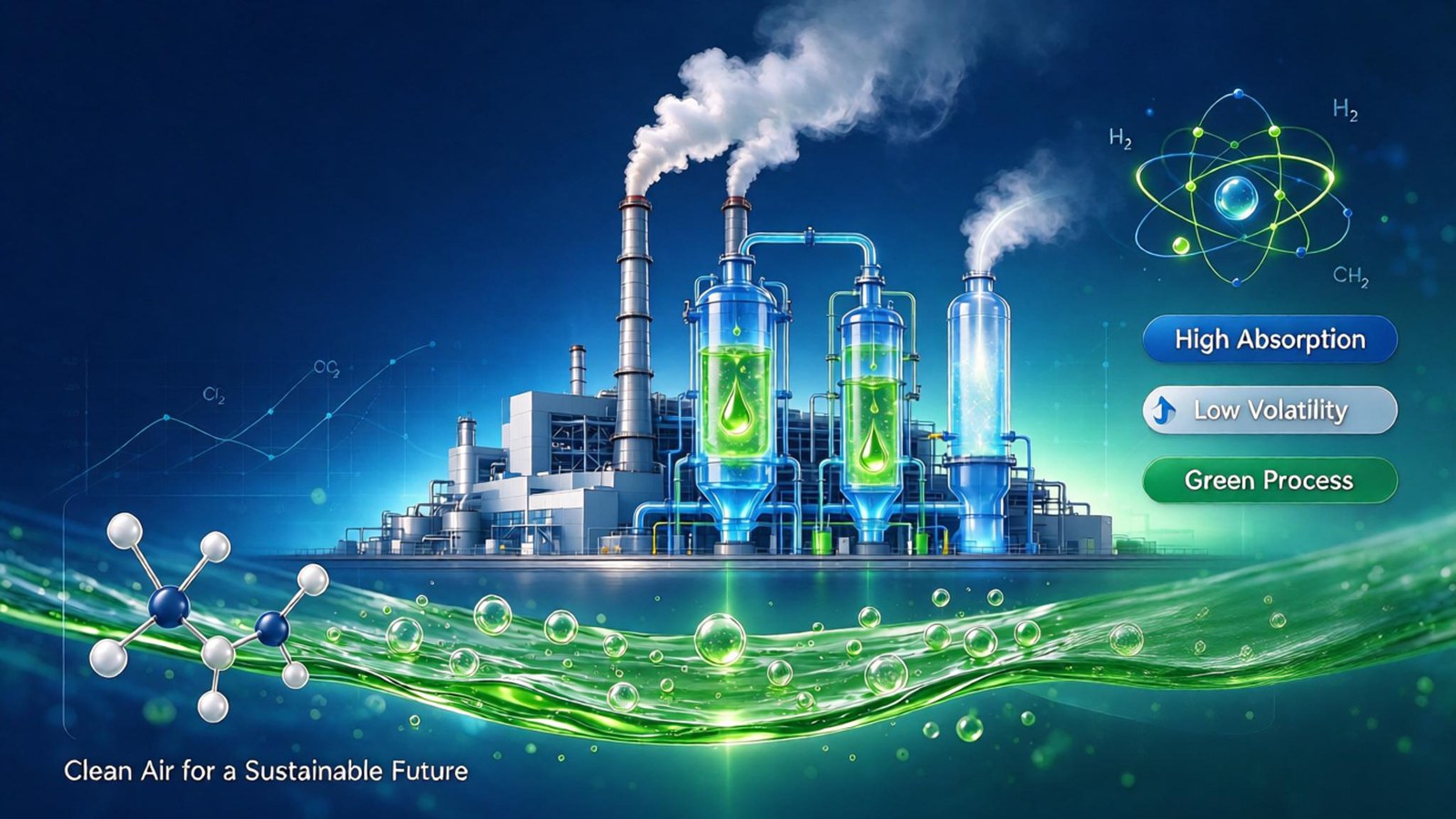
Ionic liquids are room-temperature molten salts composed of cations and anions. They feature low volatility, high thermal stability, favorable dissolving capacity and tunable chemical properties. In waste gas treatment, ionic liquids can serve as absorbents or catalyst carriers to capture and convert harmful components in exhaust gas, including VOCs, SO₂, NOₓ, etc. This technology can not only purify waste gas efficiently, but also realize resource recovery and reuse.
During the absorption process with ionic liquids, target pollutants in waste gas are first dissolved into ionic liquids, and then immobilized via chemical reactions or physical adsorption. The selective dissolving capacity and excellent mass transfer performance make ionic liquids ideal absorbents.
To ensure the efficient operation of ionic liquid systems, it is necessary to properly select ionic liquid types and optimize operating parameters such as temperature, pressure and gas flow rate.
| Parameter | Optimization approach |
|---|---|
| Selection of ionic liquid varieties | Different ionic liquids possess distinct dissolving capacities and selectivity. Normally, the optimal combination of anions and cations should be selected according to waste gas composition to achieve the best absorption performance. For instance, certain ionic liquids have high affinity for specific VOCs and can be adopted for targeted waste gas treatment. |
| Temperature control | Appropriate temperature helps improve the absorption efficiency of ionic liquids. Generally, ionic liquids deliver satisfactory performance at ambient temperature. In some scenarios, mild heating or cooling may be applied to optimize operating conditions. |
Background. A chemical enterprise generates waste gas containing high-concentration volatile organic compounds (VOCs), which cannot be fully purified by conventional absorption towers.
Solution. The enterprise adopted ionic liquid absorption technology as the primary purification method. By selecting suitable ionic liquids customized for target VOCs and optimizing operating parameters within proper ranges, the system successfully removes hazardous substances from waste gas and meets emission standards.
Operation & outcome. A complete online monitoring system was deployed for real-time tracking of key indicators to guarantee long-term stable operation.
Although ionic liquids show promising prospects in waste gas treatment, several challenges remain in practical industrial applications, including high material cost and difficult regeneration. Researchers have put forward multiple improvement strategies to tackle these bottlenecks.
| Challenge | Improvement strategy |
|---|---|
| Cost-benefit optimization | Develop new low-cost ionic liquids to cut production expenses; promote modular design for convenient maintenance and capacity expansion. |
| Improvement of regeneration technology | Explore innovative regeneration methods for ionic liquids to enhance regeneration efficiency; introduce intelligent control technology to optimize the regeneration process. |
In summary, benefiting from high efficiency and environmental friendliness, ionic liquids enjoy broad application prospects in waste gas treatment. With the development of new materials and technological advances, this technology is expected to play an increasingly important role and support the achievement of green and low-carbon development goals.

