for Lithium-Ion Batteries
Against the backdrop of fast-growing new energy vehicles and electrochemical energy storage systems, lithium-ion batteries are continuously pursuing higher energy density, longer cycle life and reliable performance under extreme temperatures. The electrolyte system is one of the most critical modules to realize these targets. Fluorinated lithium salts and fluorine-containing functional additives play an irreplaceable role, among which lithium hexafluorophosphate (LiPF₆), lithium bis(fluorosulfonyl)imide (LiFSI) and fluoroethylene carbonate (FEC) represent the most mature and widely commercialized products.
A typical lithium battery electrolyte consists of carbonate solvents, a lithium salt and functional additives. During the initial charge, the electrolyte undergoes a reduction reaction on the anode surface and forms a thin passivation layer known as the Solid Electrolyte Interphase (SEI). The quality of the SEI directly governs internal resistance, cycle life, low-temperature discharge and the thermal safety of the cell.
Fluorine delivers unique advantages here: fluorine-containing components decompose preferentially on the anode surface and build an SEI film rich in lithium fluoride (LiF). LiF features high chemical stability, oxidation resistance and excellent anti-corrosion behaviour, which prevents continuous solvent decomposition and suppresses side reactions. It is the key inorganic phase for a high-performance SEI.
2.1 Lithium Hexafluorophosphate (LiPF₆) — Dominant Base Lithium Salt
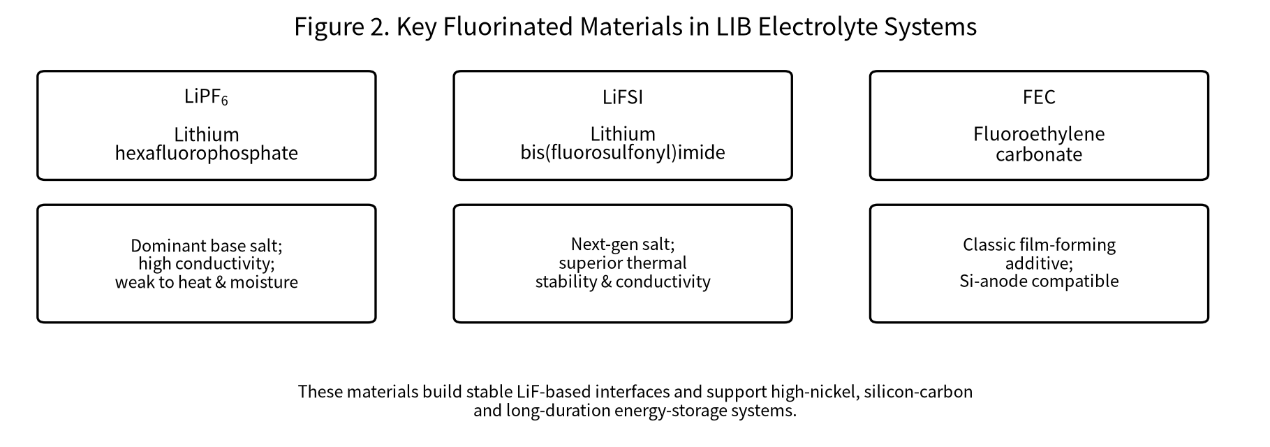
LiPF₆ is the mainstream electrolyte salt for commercial lithium-ion batteries, including power batteries and consumer batteries. It shows good solubility in carbonate solvents, high ionic conductivity and effective passivation on aluminium current collectors, and is compatible with most NCM and LFP systems.
Nevertheless, LiPF₆ has inherent limitations: poor thermal stability and high sensitivity to moisture. It hydrolyzes easily when exposed to trace water and generates corrosive HF, which accelerates cell degradation under high-temperature conditions. It is therefore usually formulated together with other fluorinated additives and new lithium salts to compensate for these weaknesses.
2.2 Lithium Bis(Fluorosulfonyl)imide (LiFSI) — Next-Generation Fluorinated Salt
LiFSI is a promising alternative fluorinated salt with remarkably better thermal stability and a lower hydrolysis tendency than LiPF₆. It provides superior ionic conductivity and fits high-nickel cathodes and silicon-based anodes that target high energy density.
In high-nickel systems, LiFSI helps stabilize the cathode interface and suppress transition-metal dissolution. When combined with FEC, it synergistically constructs robust SEI layers and greatly improves high-temperature storage and long-cycle performance. Today LiFSI is widely used as a co-salt with LiPF₆ and has been mass-adopted in premium power and energy-storage batteries.
2.3 Fluoroethylene Carbonate (FEC) — Classic Film-Forming Additive
FEC is the most widely adopted fluorinated additive in the lithium battery industry. It has a higher reduction potential than common carbonate solvents, so it decomposes prior to the solvent molecules and forms a dense LiF-rich SEI film.
For silicon-carbon anodes, the huge volume expansion during cycling easily cracks a conventional SEI and triggers continuous side reactions. The flexible fluorinated interface derived from FEC accommodates the volume variation of silicon and maintains interface stability. FEC also helps reduce low-temperature polarization and improves rate-discharge performance.
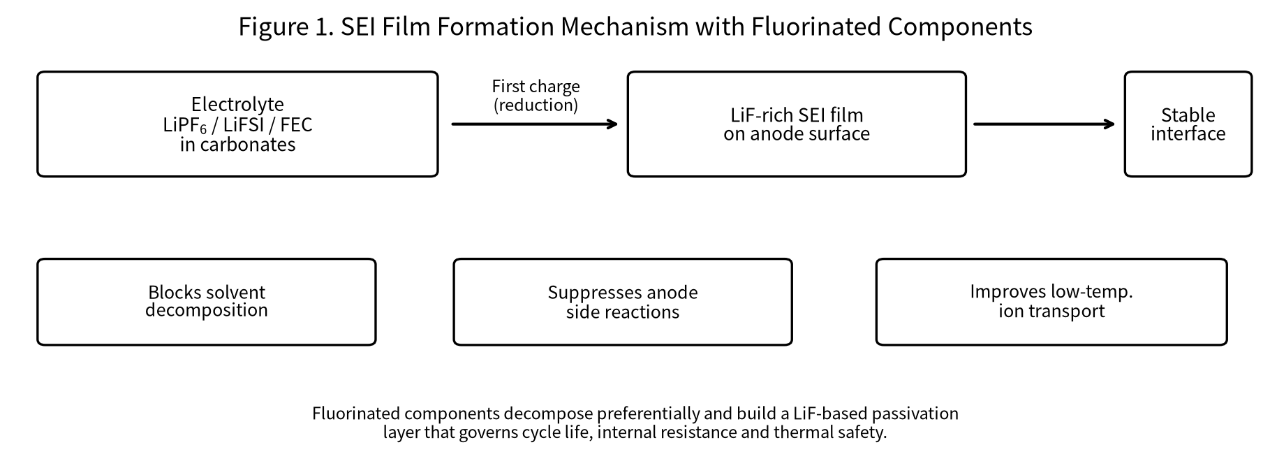
The working mechanism can be summarized in four aspects. First, preferential reduction and film formation: FEC and fluorinated lithium salts decompose first on the anode surface to form LiF-based passivation layers. Second, suppression of electrolyte decomposition: the stable SEI isolates active anode sites from solvent molecules and blocks persistent reduction. Third, cathode interface protection: fluorinated salts such as LiFSI build protective layers on high-nickel cathodes to inhibit oxidation and metal leaching. Fourth, improved low-temperature ion transport: fluorinated interfaces facilitate ion conduction and reduce low-temperature polarization.
Process note: Fluorine-containing electrolytes demand strict water control. Trace moisture causes hydrolysis of fluorinated lithium salts and generates hydrogen fluoride, which leads to cell swelling and rapid capacity decay. Production and electrolyte filling are therefore operated under anhydrous and oxygen-free conditions.
As power batteries evolve toward high-nickel, silicon-carbon, large-format cells and long-duration energy storage, conventional single-salt LiPF₆ systems can no longer satisfy advanced requirements. Fluorinated lithium salts and additives belong to high-value fine chemicals in the lithium supply chain, with high technical barriers in fluorination synthesis, purification, moisture control, impurity management and stable formulation.
The upstream supply chain includes basic fluorochemical raw materials such as hydrogen fluoride and fluorinating reagents; the midstream covers LiPF₆, LiFSI, FEC and other fluorinated additives; downstream customers are power batteries, energy-storage batteries and consumer-electronics batteries. Chinese fluorinated lithium-battery materials have become a core competitive advantage in the global lithium supply chain, supporting the continuous energy-density upgrading of batteries.
From the foundational lithium salt LiPF₆ to the advanced salt LiFSI and the film-forming additive FEC, fluorinated materials constitute the backbone of lithium-ion battery electrolytes. The LiF interface originating from fluorine chemistry is the cornerstone of a stable SEI, solving the interface-failure bottleneck of high-nickel cathodes and silicon anodes.
With the rising demand for cycle life, safety and low-temperature performance from the EV and energy-storage markets, fluorinated electrolyte additives and novel fluorinated lithium salts will keep evolving and remain a key development direction for fine fluorochemicals in the new energy sector.

