Application Cases of Trifluoromethyl and Fluorobenzene Pharmaceutical Intermediates
Within the global new drug discovery pipeline, fluorine-containing drugs account for a growing share. Fluorine serves as a classic and highly effective structural modifier for drug molecules. Fluoroaromatic moieties including trifluoromethyl (-CF) and difluorophenyl groups are among the most high-value and large-volume pharmaceutical intermediates, underpinning the commercial manufacturing of blockbuster antiviral, anticancer, anti-infective and antifungal agents. 2,4-Difluorophenyl and 4-trifluoromethylaniline (4-TFMA) are two exemplary core building blocks.
Fluorine-containing drugs now account for a steadily growing share of globally marketed new medicines. Fluorine is the most electronegative element, and the C–F bond is exceptionally strong. Introducing a trifluoromethyl group (-CF₃) or ring fluorine atoms into a drug molecule improves developability along three dimensions:
Improving Lipophilicity and Absorption. The strongly lipophilic trifluoromethyl group enhances the ability of a molecule to penetrate cell membranes, improving oral absorption and raising bioavailability.
Enhancing Metabolic Stability. Fluorine suppresses oxidative degradation of the aromatic ring by hepatic CYP450 enzymes, prolonging the in-vivo half-life of the drug and reducing dosing frequency.
Optimizing Target Binding. The unique dipole and hydrogen-bonding interactions of fluorine enable a precise fit into protein binding pockets, increasing binding affinity and reinforcing efficacy.
In short, fluorine is not simply a “replacement atom”; it acts as a performance regulator of the drug molecule. This is why the industry often describes the fluorine atom as the “sharp tool” of drug modification.
2.1 2,4-Difluorophenyl Intermediates
The 2,4-difluorophenyl moiety is a hallmark scaffold of triazole antifungal drugs, and its most classic downstream product is fluconazole. The chemical core of fluconazole is α-(2,4-difluorophenyl)-α-(1H-1,2,4-triazol-1-ylmethyl)-1H-1,2,4-triazol-1-ylethanol. Relying on the 2,4-difluoro-substituted benzene ring, it selectively inhibits fungal lanosterol 14α-demethylase and delivers broad-spectrum antifungal activity, with clinical use against Candida and Cryptococcus infections. Fluconazole remains one of the classic antifungal APIs worldwide.
Beyond antifungals, this scaffold is also applied in the synthesis of the quinolone antibacterial tosufloxacin, certain anti-HIV intermediates, and a number of kinase inhibitors, sustaining growing volume across the anti-infective and antiviral pipelines.
2.2 4-Trifluoromethylaniline (CAS 455-14-1)
4-Trifluoromethylaniline is a typical aromatic trifluoromethylated intermediate. Its amino group supports diazotization, acylation, coupling, and cyclization reactions, making it a key building block for immunology, anti-inflammatory, and antitumor drugs.
It serves as a related-substance reference for leflunomide and teriflunomide, and is heavily used in the synthesis of JAK inhibitors, BTK inhibitors, and targeted kinase-based antitumor drugs. The scaffold is also frequently employed in central-nervous-system and anti-inflammatory small-molecule research. The para-positioned -CF₃ group substantially improves metabolic stability and reduces oxidative metabolism of the benzene ring.
3.1 Route to 2,4-Difluorobenzene Intermediates
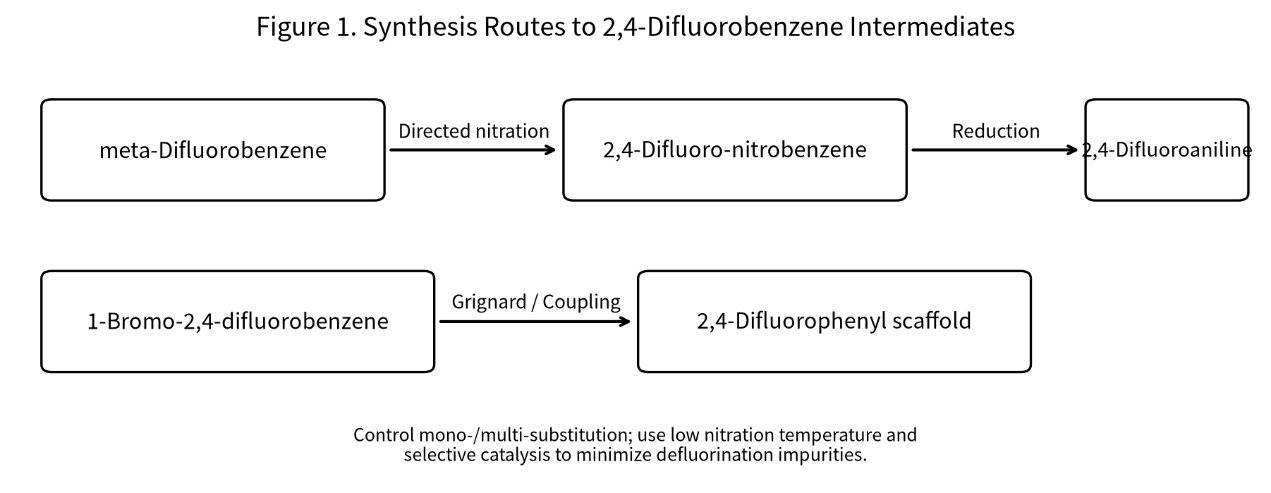
The mainstream industrial route starts from meta-difluorobenzene, which is converted by directed nitration and reduction into 2,4-difluoroaniline; alternatively, halogenated aromatics such as 1-bromo-2,4-difluorobenzene undergo Grignard or coupling reactions to build the desired scaffold.
Because fluorine atoms exert strong directing effects on the aromatic ring, the technical difficulty lies in controlling mono- versus multi-substitution by-products. Industry therefore prefers low nitration temperatures and selective catalytic systems to minimize defluorination impurities and secure downstream API quality.
3.2 Route to 4-Trifluoromethylaniline
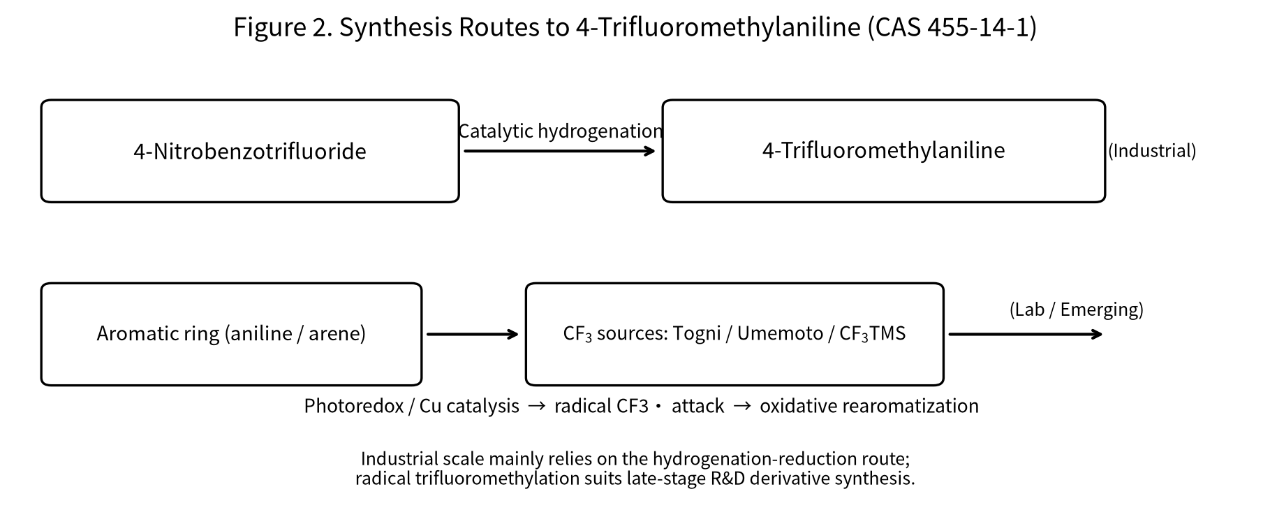
The classic industrial route is the reduction of 4-nitrobenzotrifluoride, in which the nitro group is hydrogenated catalytically to the amino group.
For laboratory and emerging processes, direct aromatic trifluoromethylation is employed using trifluoromethyl sources such as Togni reagent, Umemoto reagent, or CF₃TMS under photoredox or copper catalysis, enabling late-stage trifluoromethylation of anilines or arene rings.
Radical trifluoromethylation is a frontier direction. Its advantage is that the CF₃ group can be introduced during late-stage drug modification for rapid generation of derivatives in the R&D phase; its drawback is the relatively high reagent cost, so large-scale production still relies mainly on the hydrogenation-reduction route.
Core mechanism: the trifluoromethyl radical attacks the aromatic ring and completes point-specific introduction via oxidative rearomatization. Once the C–F bond is formed, it is difficult to break under routine conditions, conferring excellent stability on the molecule.
Fluoroaromatic intermediates belong to the high-value-added, high-technological-barrier segment of the pharmaceutical intermediate market. Ordinary aromatic intermediates face low entry barriers and intense competition, whereas fluoroaromatics impose stringent requirements for fluorination, trifluoromethylation, impurity control, explosion prevention, and waste treatment, building a considerable technical moat.
Viewed along the value chain:
With the continued overseas expansion of Chinese innovative drugs and the advancement of generic-drug consistency evaluation, overseas pharmaceutical companies also procure large volumes of domestic fluoroaromatic intermediates. Fluorinated building blocks have become a competitive export segment of China’s fine-chemical industry.
Trifluoromethyl and fluorobenzene intermediates represent the most mature carrier of the “fluorine effect” in the pharmaceutical field. The 2,4-difluorophenyl scaffold supports antifungal and anti-infective drugs, while 4-trifluoromethylaniline serves immunology and targeted antitumor agents. From a synthetic perspective, site-specific fluorination and trifluoromethylation are standard tools for optimizing small-molecule structures.
During the molecular design stage of new drugs, researchers routinely evaluate fluorination strategies to solve such pain points as poor lipophilicity, fast metabolism, and weak target binding. This makes it certain that, for a long time to come, fluorobenzene and trifluoromethyl pharmaceutical intermediates will remain irreplaceable core raw materials in the drug supply chain.

